
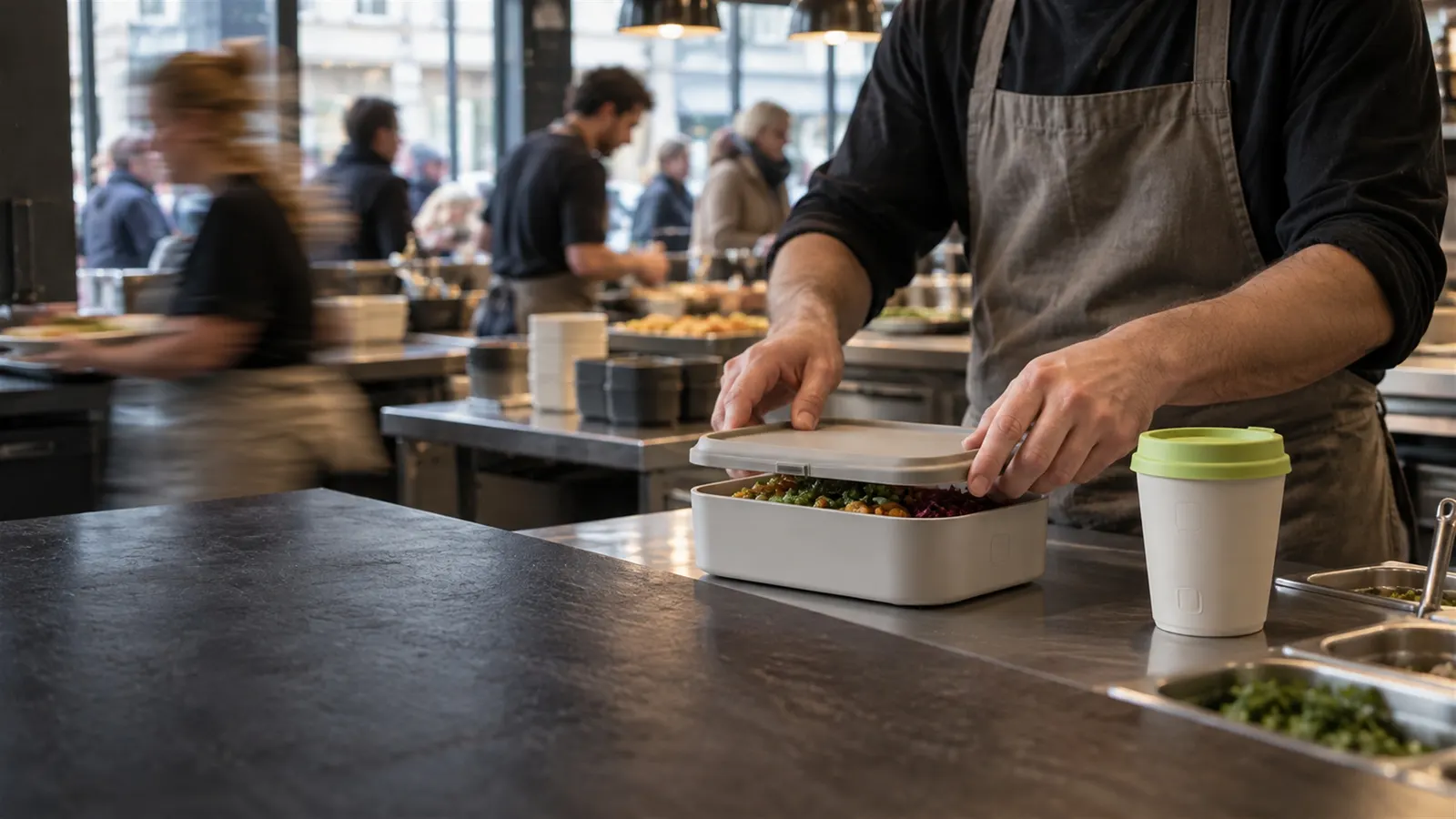
Reusable takeaway packaging without your own system.
You get packaging, return machines, software, and deposit handling in one system. Customers return containers anywhere on the network, without an app.
What you get.
Traceable packaging
Cups, bowls, boxes, and more, each with its own code.
Neutral or branded
The neutral container costs least. Branded ones are a premium option.
Return machines
Customers return at any Retoer point and get their deposit back.
Tracking and reports
Follow every container and find your PPWR reports in your Retoer dashboard.
Linked to your till
Your point-of-sale system adds the deposit, so staff keep no separate record.
Deposits handled
We set up the deposit, hold the ledger, and handle refunds.
Washing and logistics
Partners collect, wash, and bring back your containers.
A toolkit for your staff
A communication toolkit based on lessons from Denmark.
Takeaway is more than drinks.
Single-use burger boxes a year in Flemish horeca.
Source: OVAMSingle-use fries trays a year in Flemish horeca.
Source: OVAMOpen network or closed loop.
| What matters | Retoer | Closed-loop scheme |
|---|---|---|
| Where containers go back | Any Retoer return point | Only the operator's own partners |
| What your customer needs | A deposit, nothing else | Often an app or an account |
| Who holds pool and deposits | A neutral administrator | The operator |
| If the operator stops | The system keeps running | Containers and deposits are at risk |
| How it grows | Into one national network | One brand at a time |
Typical setups compared. Individual schemes differ.
Where the money comes from.
Participation is designed to cost a business no more than single-use packaging. Deposits, per-return fees, packaging, public co-funding of return points, and pilot budgets pay for it. The pilots set final prices and the deposit amount.
One of Retoer's seven design principles: reuse never looks more expensive at the counter.
Read more: What does reusable takeaway packaging cost a restaurant?
Ready for PPWR.
Under the EU Packaging and Packaging Waste Regulation (PPWR), customers can bring their own container at no extra cost from 2027. From 2030, single-use plastic is banned for on-site consumption. Retoer helps you meet both rules without building your own return system.
Read more: PPWR for horeca: what restaurants and takeaways must do in 2027, 2028, and 2030
All dates, the deposit rules for bottles and cans, and the sources: Regulation on docs.retoer.be
Questions from horeca.
Is it free for my restaurant?
Participation is designed to cost a business no more than single-use packaging. Deposits, per-return fees, packaging, public co-funding of return points, and pilot budgets pay for it.
Do my customers need an app?
No. The target is an app-free return in under 30 seconds, with the deposit refunded to a bank card. The pilots test the final flow.
Can I keep my own branded containers?
Yes. Branded containers run on the same network as a premium option, because separate sorting costs more. The neutral shared container costs least.
What happens if an operator stops?
The system keeps working. The pool, data, and deposits sit with a neutral administrator, not with an operator.
How is Retoer different from other reuse providers?
Retoer supplies the same building blocks: packaging, return machines, software, and deposit handling. The difference is where containers go back. Your customers return them at any Retoer point without an app or account, and your setup connects to one national system.
Is Retoer Belgian?
Yes. Retoer is built in Belgium for Belgian horeca and cities, in collaboration with Thomas More University of Applied Sciences.
I already use another reuse scheme. Can it connect?
Yes. Other schemes can use Retoer's return points, washing, and logistics and keep their own brand. Talk to us about connecting.