
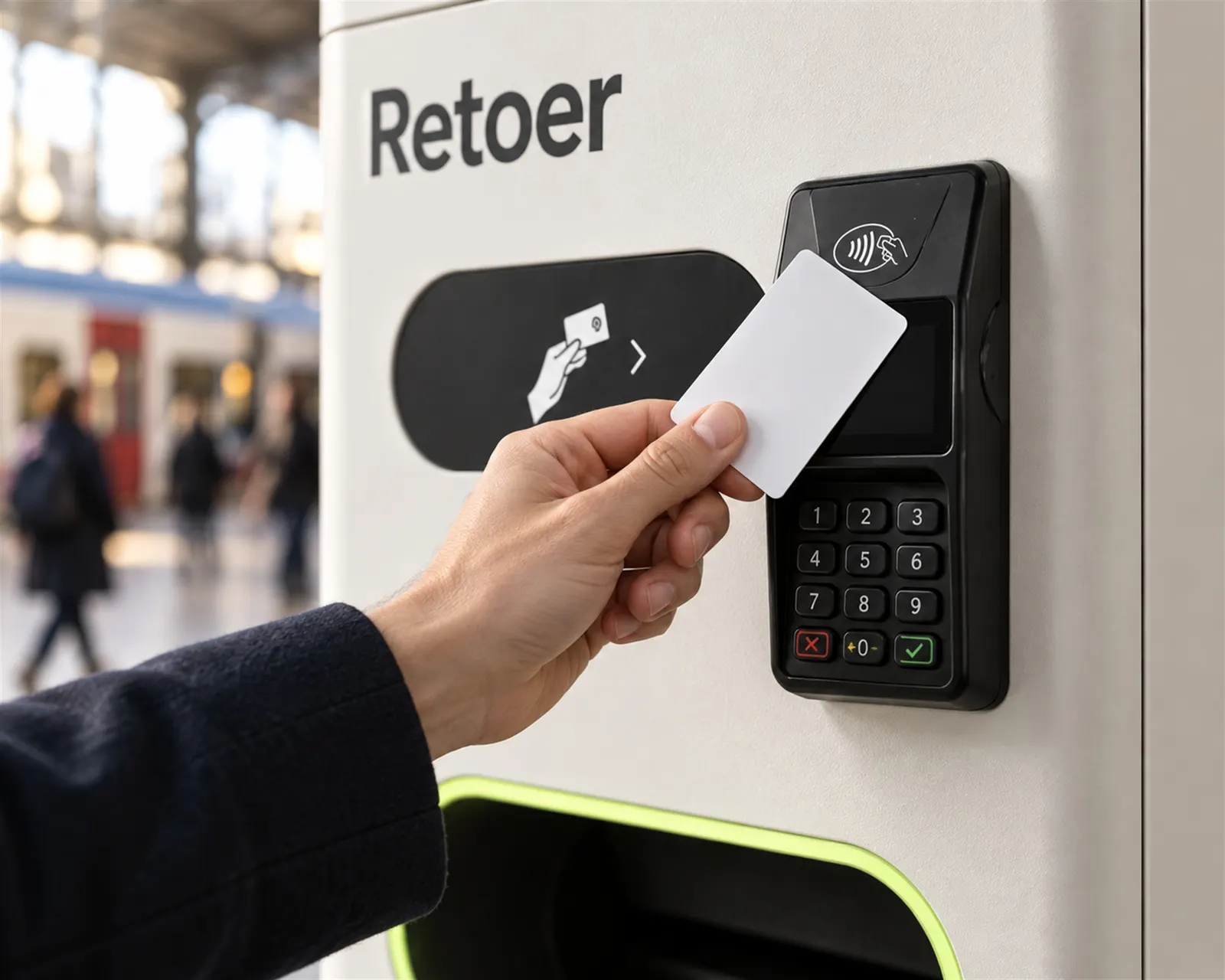
A reusable cup return without an app works because it asks for nothing the person doesn’t already carry. An app adds steps (install, register, scan, wait) at the moment someone holds an empty cup and has somewhere to be. Where a scheme asks for those steps, containers stay in bags and bins. Where the refund goes to a bank card, they come back. That is why Retoer’s first design principle is app-free return: tap a bank card, done in 30 seconds.
Why do app-based reuse systems lose containers?
The return is the weakest moment in any reuse system. The person has already used the cup and has no reason left to care about it. Every extra step competes with a train, a meeting, or a friend waiting outside.
An app also puts a barrier in front of the people a public system needs most: visitors, tourists, and anyone who tried the scheme once and never came back. A system in public space has to work for a stranger on their first day.
What Kooky asked of its users
Kooky, a Swiss scheme, used an app, QR codes, and special return boxes. It left SBB stations in July 2024 and then closed down, according to Blick, despite major partners.
A closure has many causes, and this post doesn’t claim the app was the one. Still, the design asked users to do things most takeaway customers will not do twice. Retoer reads the case as a lesson: app friction in public space is a risk a system cannot afford.
Aarhus refunds to the bank card
Aarhus took the other route. The city tendered one system, and the deposit goes back to the customer’s bank card. From January 2024 to December 2025, more than 1.6 million cups were returned, a 91% return rate, according to the European Commission. The most-used cups made 33 loops in the first year, according to TOMRA. Our post on how Aarhus returns its cups explains the rest of the setup.
Card refunds are not the only reason Aarhus works. It also has a dense network of return machines and one standard cup. But the card removes the step where most schemes lose people.
Copenhagen and Lisbon follow the same route
Copenhagen has 34 return stations in the city center, installed by November 2025, according to the City of Copenhagen. The operator, New Loop, and Mastercard announced card-tap refunds in April 2026, according to Mastercard.
Lisbon launched in June 2025 as the first EU capital with a city-wide reusable cup system, with a €0.60 deposit and refund by card tap, according to EU Transition Pathways.
Three cities, three different settings, one common choice: the refund goes where the person’s money already is.
What app-free means for Retoer
App-free is a target experience, and it is tested in pilots. Retoer describes it this way:
- The person buys a meal or drink in a reusable container and pays a small deposit.
- They return the container at a kiosk, a return machine, or a participating business.
- The deposit comes back in under 30 seconds. Depending on the setup, it goes to a bank card, arrives by digital transfer, or comes as a QR code or barcode voucher for the next purchase.
- To find a return point, the person scans the code on the container with the phone camera. A web page opens with a map and the walking route to the nearest one. No app and no account.
The current kiosk demonstrator works with a QR scan, camera verification of the container, and a €0.30 deposit refund. That is a demonstrator, not the final flow. The final consumer flow is a design choice tested in the pilots.
Apps are not banned. Consumer profiles, points, and reminders exist as options for people who want them. The return itself never depends on one.
What cities and initiatives can ask for
Whoever tenders, funds, or builds a reuse system can write the principle into the requirements:
- Return and refund without an app or an account.
- Refund to a payment method people already hold.
- A target time for the return, such as 30 seconds.
- Return points that any participating business or initiative can share.
An app-free return only works with enough return points nearby, which is the question in our post on how many return points a system needs. The German experience shows what happens when a rule fixes the offer but not the ease of returning: see why Germany’s reuse obligation reached 1.6%.
Retoer is an open infrastructure for reusable packaging with deposit in Belgium, developed with Thomas More University of Applied Sciences. Rotion is the first technology provider helping to launch it, and other providers can join on the same open standard. For policy makers, see what Retoer offers policy makers.
If you run or plan a reuse scheme and want to compare notes on the return, get in touch with the Retoer team.