
A city reusable cup system works when there is one system to return a cup to and returning it takes almost no effort. Aarhus, in Denmark, shows what that looks like across a whole city. According to the European Commission, more than 1.6 million cups were returned there between January 2024 and December 2025, with a 91% return rate. Those results follow from three design choices: the city tendered one system, the deposit goes back to a bank card, and return machines are close together. Below, we tie each result to its choice and look at what a Belgian city would need to do the same.
Aarhus is not a Retoer system. It is one of the international cases Retoer’s design principles are built on.
What Aarhus measured
Two numbers describe the system. The first is the return rate: 91% over two years, according to the European Commission. The second is how often a cup goes around. According to TOMRA, which operates the system, the most-used cups made 33 loops in the first year. That figure describes the most-used cups. It is not an average for every cup.
Impact in reuse follows from those two numbers. A cup only replaces single-use packaging if it comes back, gets washed, and is used again, and every extra loop is one more use of the same cup.
Why does Aarhus get 91% of its cups back?
Aarhus makes returning a cup simple at every step. There is one system across the city, so every cup goes back to the same machines. The deposit is refunded to a bank card, so nobody needs an app or an account. And returning is quick, at a dense network of return machines.
One tendered system for the whole city
Aarhus tendered a single system for the city, and TOMRA operates it. For the person holding a cup, that means one rule everywhere: any cup goes into any machine.
The opposite is a patchwork. Each initiative has its own cup, its own deposit, and its own return point, so a cup bought in one place can’t go back in another. Germany shows where that leads. Businesses there have to offer a reusable option, but there is no levy, no enforcement, and no shared system. According to WWF Germany, the reuse share in takeaway rose only from 0.7% in 2022 to 1.6% in 2023.
Two of Retoer’s design principles come from this lesson. Principle 3 asks for one neutral standard pool, with branded packaging as a premium option that is sorted separately. Principle 7 treats policy as an ally, with a model tender for cities so that local procurement converges on one open standard. Retoer adds one more principle: the pool, the data, and the deposits sit with a neutral administrator and never with an operator (principle 6). That keeps the system running if one operator stops, a question we cover in who owns the deposits.
A refund to your bank card, without an app
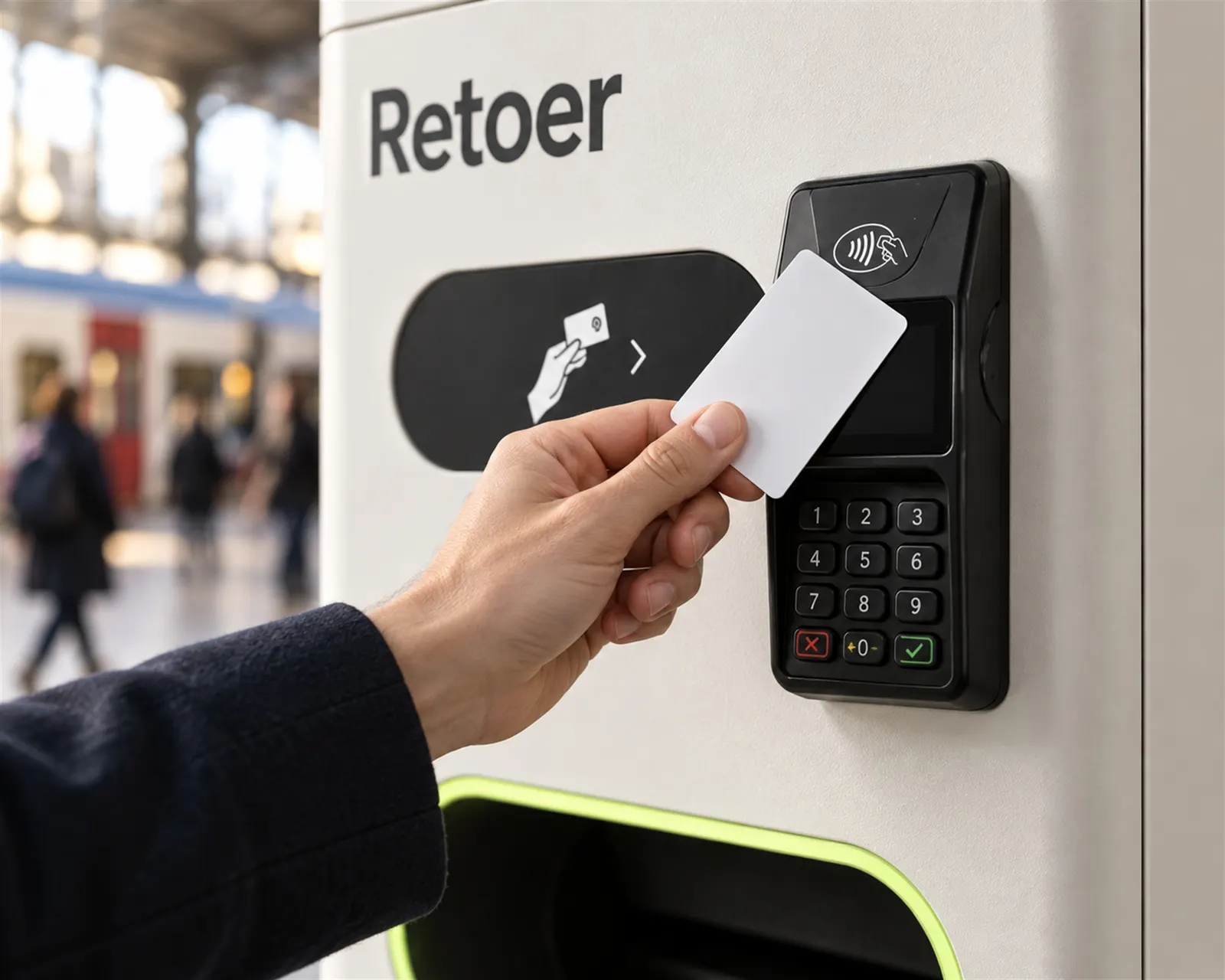
In Aarhus, the deposit goes back through a bank card. You don’t download anything or create an account before you can return a cup.
Systems that fail often share the opposite: friction through apps and registration. Kooky, a Swiss system built on an app, QR codes, and special return boxes, shut down despite having major partners. Retoer’s first design principle takes the lesson from both cases: return without an app, by tapping a bank card, in under 30 seconds. That is a target for the experience, and the final consumer flow is tested in the pilots.
The deposit itself matters too. Principle 2 asks for a prepaid deposit that people notice, kept low and the same across the whole system. Upfront deposits are common in reuse: according to Zero Waste Europe, 81% of the 90 cases analyzed in the Reuse Barometer use one.
Return machines close together
The lesson Retoer takes from Aarhus is app-free return combined with high machine density. A card refund helps only if a machine is nearby when someone finishes a drink.
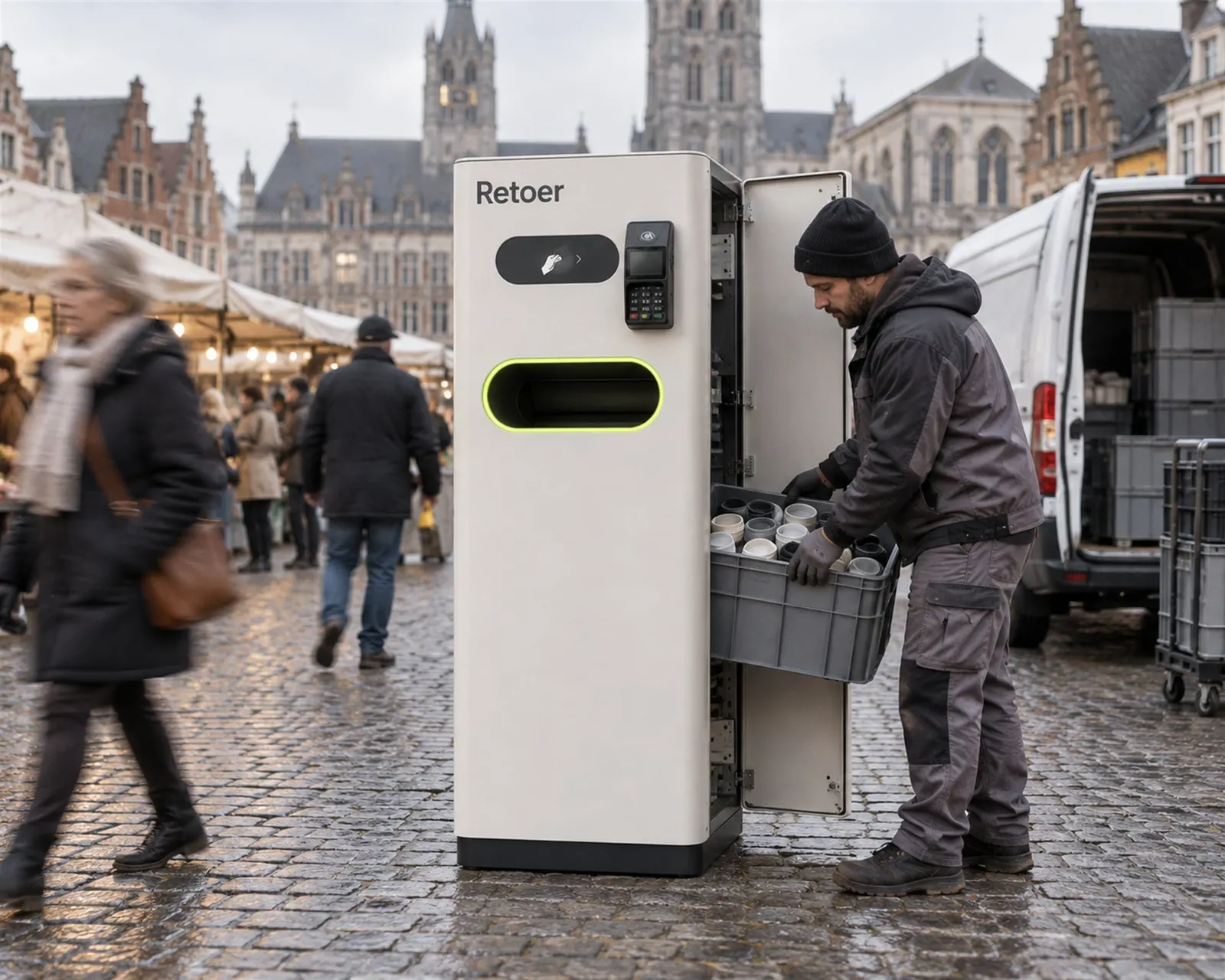
Retoer turns this into a hard rule. Principle 4 sets a minimum density for return points, and an area has to meet it before rollout starts. Return points count as public infrastructure, comparable to public waste bins.
What a Belgian city reusable cup system would need
What Belgium can take from Aarhus are the choices around the machines. They translate into a short list.
- One standard across municipalities. A model tender lets each city procure on its own while every tender converges on the same open standard, so cups can move between them.
- App-free return with a card refund, designed to take under 30 seconds.
- A minimum density of return points, checked before rollout in any area.
- A neutral administrator that holds the pool, the data, and the deposits.
- Policy that helps: a price incentive on single-use packaging and reuse requirements in public procurement and at events.
Retoer is building this as an open infrastructure for reusable packaging with deposit in Belgium, developed with Thomas More University of Applied Sciences. Rotion is the first technology provider helping to launch it, and other providers can join on the same open standard. Retoer tests the system in municipalities of different sizes and in high-traffic zones. For the policy side, see what Retoer offers policy makers. For the municipal side, including the model tender and return-rate dashboards, see Retoer for cities and municipalities.
If you work on reuse for a city, a municipality, or a government, we would like to hear what your area needs. Get in touch with the Retoer team to talk about your municipality.