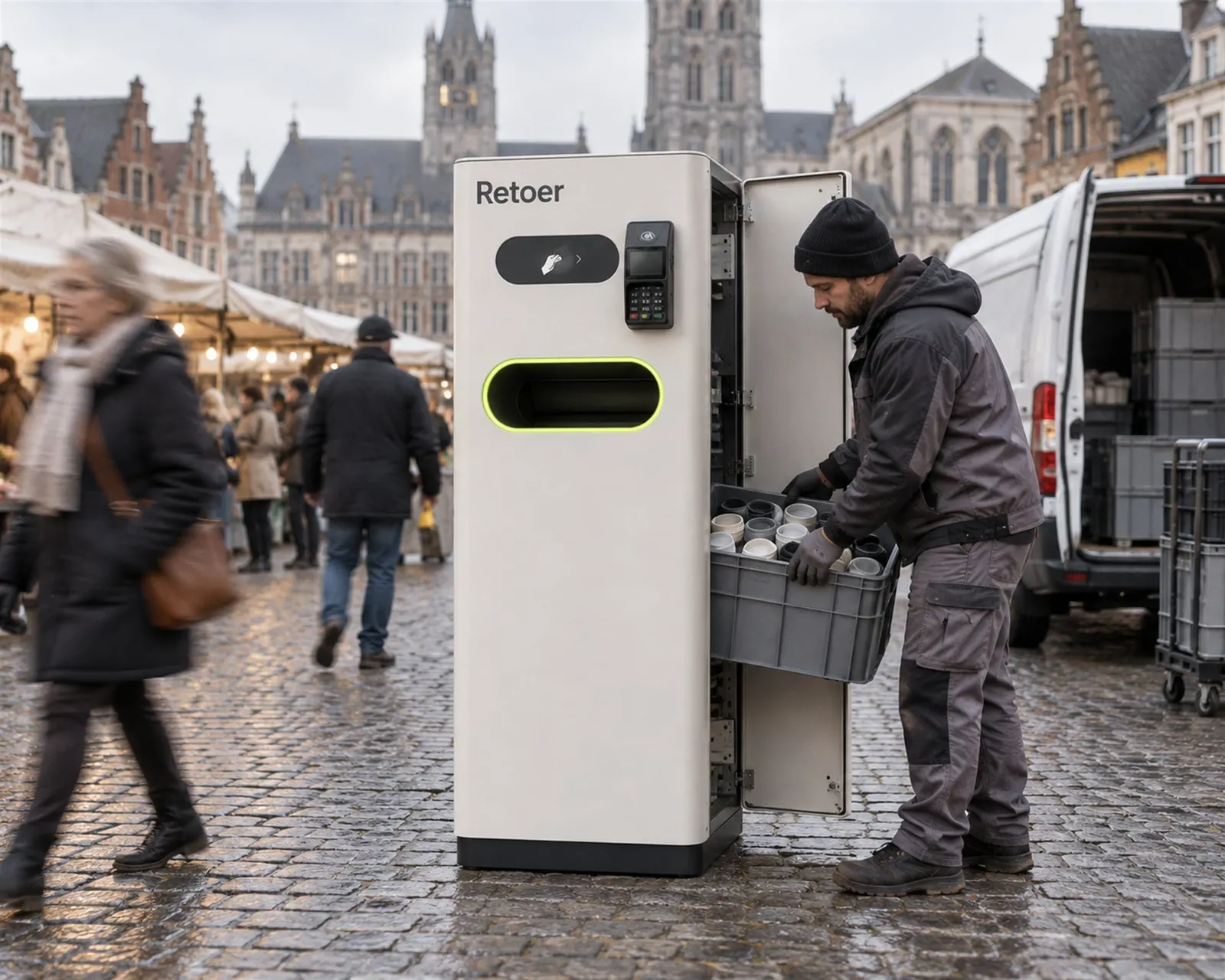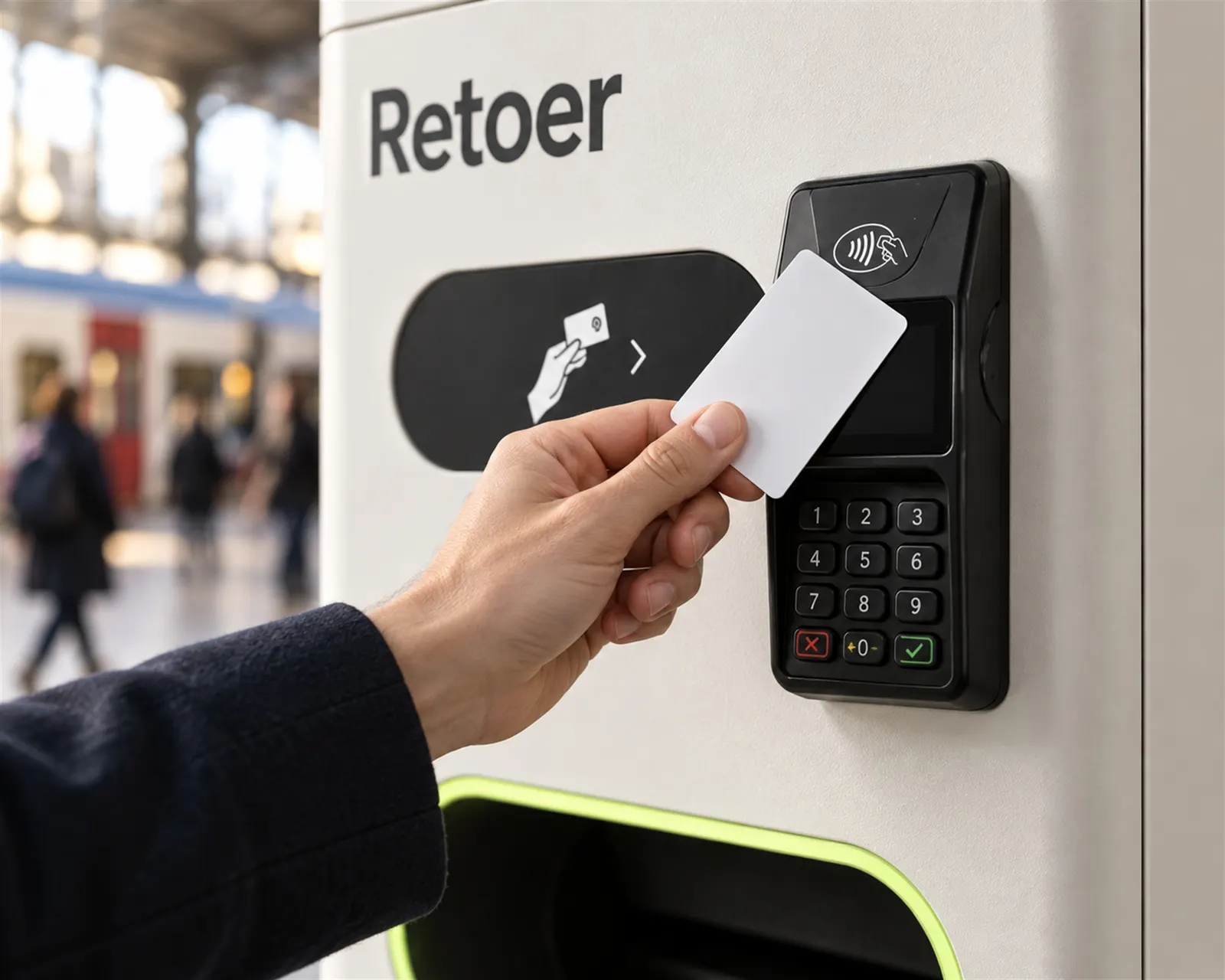

Nobody can yet give a proven number of return points for a city, and Retoer doesn’t publish one it hasn’t confirmed. What the evidence does show is the rule behind the number: containers come back when returning is on the way, so a minimum density of return points has to be in place before a system rolls out in an area. Retoer treats that as a hard criterion, and studies the exact figures with Thomas More University of Applied Sciences.
Is there a minimum number of return points?
Yes, but it depends on the place. A station hall, a shopping street, and a village square each need a different spread. The useful question for a city is not “how many in total” but “how far does someone walk with an empty cup, and does that fit their day”.
That is why the number comes from testing in real settings, not from a formula. Until the tests report, any figure quoted for “the right density” is a guess.
Why density decides whether containers come back
A person holding an empty cup decides within seconds. If a return point is on the route, the cup goes back. If it needs a detour, the cup goes in a bag, then a bin, or stays at home.
Every missing return point costs returns twice. The container is lost to the system, and the deposit stays unclaimed, which teaches the person that reuse is more effort than single-use. Reuse never wins that comparison unless returning is close to effortless.
What Aarhus and Copenhagen show
Both Danish cities built dense networks before asking people to return anything.
In Aarhus, the city tendered one system and refunds the deposit to a bank card. From January 2024 to December 2025, more than 1.6 million cups came back, a 91% return rate, according to the European Commission. Our post on how Aarhus gets its cups back covers the setup.
In Copenhagen, 34 return stations were installed across the city center by November 2025, according to the City of Copenhagen. Businesses there get financial support based on their single-use volume.
Neither city published a rule of thumb you could copy. What they share is a network that was planned as a whole and one standard behind it.
Why a density standard comes before rollout
Retoer’s fourth design principle is a density standard for return points: a minimum density is a hard criterion before rollout in any area.
The reasoning is practical. A thin network produces low return rates. Low return rates produce losses, and losses make the system look like it fails. A launch in an area that is not covered well enough tells a city and its businesses the wrong thing about reuse.
So the standard works as a gate. If an area meets the minimum, the system can open there. If it doesn’t, more return points come first.
Return points as public infrastructure
Return points work best when a city treats them like public waste bins: placed where people already walk, open to every business and every resident, and part of one network instead of one per initiative.
The alternative is what many Belgian towns have now. Each initiative places its own boxes, serves its own customers, and stays too small to reach any density. Several systems in one street means several thin networks.
One open network lets the same return point serve a kiosk, a return machine, or a participating business. A person finds the nearest one by scanning the code on the container: a web page opens with a map and the walking route. No app and no account.
What Retoer studies with Thomas More
Density and placement is one of the joint research lines with Thomas More: how many return points, where, and in which form.
Retoer tests the system in municipalities of different sizes and in high-traffic zones such as train stations. Each test cycle checks return rate, rotations, losses, costs, and behavior against a fixed learning framework. Comparing sizes shows where density holds and where the lower limit lies. The results go into a blueprint that any region can use.
What a city can do now
A city does not need to wait for the figures to prepare. Four steps help in any case:
- Map where people walk with takeaway today: stations, shopping streets, campuses, event sites.
- List public buildings and businesses that could host a return point.
- Ask existing reuse initiatives to share return points instead of placing their own.
- Write density into the tender as a requirement, not a wish.
Retoer is an open infrastructure for reusable packaging with deposit in Belgium, developed with Thomas More University of Applied Sciences. Rotion is the first technology provider helping to launch it, and other providers can join on the same open standard. Organizations can start in their own setting now, because a local setup runs on the open standard and joins the national system as it grows. For the city view, see what Retoer offers cities and municipalities, or read how the system works.
If you plan reuse for a Belgian city, we would like to compare notes. Get in touch with the Retoer team.